The Same Scams, Two Maps: Fraud That Works in the Lower 48 and in Alaska

A scam does not need to understand Alaska’s geography to work here.
It only needs a person under pressure, an official-looking story, and a reason to act before verifying the facts.
The same fraud patterns operate in Texas suburbs, Florida communities, New York parking areas, and Alaska neighborhoods. The setting changes. The mechanism does not.
This article examines three categories that are active in both the Lower 48 and Alaska:
- Contractor and home-repair fraud
- QR-code and fake-notice scams
- Romance and investment fraud, often called “pig butchering”
The examples below come from published reporting and government sources. Criminal charges are allegations unless and until proven in court.
1. Contractor Fraud Needs No Technology
Contractor fraud is one of the oldest scams in the book. It has nothing to do with technology.
Someone knocks, calls, advertises, or posts online. The price sounds attractive. The money moves up front. The work is unfinished, unnecessary, defective, or actively damaging.
That formula works in a suburb of Dallas and in a subdivision outside Wasilla because the vulnerability is social, not digital.

The Maine Contractor Found in Alaska
A July 2025 report by the Bangor Daily News and Fox 23 Maine described a particularly instructive cross-state example.
Jake Brown, 37, who operated JBRH Excavation and Welding Fabrication in Maine, was arrested in Palmer, Alaska, on July 21, 2025. He was wanted in Kennebec County on allegations involving theft by deception and home-repair fraud.
Brown was held in Alaska while Maine considered extradition. The Kennebec and Somerset County district attorney later declined to bring him back because of the cost. Alaska law enforcement released him, and the Maine warrant remained active at the time of the reporting.
Earlier in 2025, the Maine Attorney General’s Office entered an agreement requiring Brown to pay $350,000 over 15 years through monthly installments to be distributed to victims. That followed a January finding that he was liable for $2.5 million in restitution and barred from performing excavation or construction work in Maine.
A December 2024 complaint alleged that his company performed defective work on at least 14 occasions and failed to complete work in at least 20 instances since 2022.
The charges remain allegations. Brown is presumed innocent unless proven guilty.
The practical lesson is not merely that a contractor may cross state lines. It is that distance can create a recovery problem. A contractor accused in one state was located more than 3,000 miles away, and the prosecuting county decided that the cost of bringing him back was not justified.
The Manufactured Roof Problem
In August 2026, Levy Aaron Lee pleaded guilty in Texas to financial abuse of an elderly person involving between $30,000 and $150,000.
According to an affidavit reported by Alaska’s News Source, Lee and a co-conspirator told a 71-year-old woman that her roof was unstable. They collected six checks and $14,000 in cash, totaling $64,000.
The affidavit alleged that the men caused damage themselves and covered it poorly with approximately $1,800 in paint, roofing tiles, and uneven plywood. Independent contractors later testified that the roof did not need repairs before the damage and that four new roofs could have been purchased for the amount paid.
The state agreed to five years of probation and repayment of the $64,000.
This is the manufactured-problem technique: create fear, present yourself as the immediate solution, and collect money before the customer has time to obtain an independent opinion.
The same national pattern has included a Florida contractor found guilty of cheating an 87-year-old out of nearly $40,000 in post-hurricane work and a Naples contractor who pleaded guilty in a $1.26 million hurricane-repair fraud.
Alaska-Specific Checks
Alaska’s seasonal building window can create pressure. Exterior work is compressed into a short stretch of the year, and homeowners who wait for that same window are motivated to say yes quickly.
In remote or road-limited communities, checking references and licensing can also be more difficult. That makes verification more important before money moves.
For residential work, look the contractor up through Alaska’s Division of Corporations, Business and Professional Licensing, which maintains a public license search. Confirm the license yourself and check whether the required residential endorsement appears in the record. Do not rely only on a business card, document, or number supplied by the contractor.
Alaska’s Unfair Trade Practices and Consumer Protection Act may allow a homeowner to recover up to three times actual damages in some circumstances. This is general information, not legal advice. Speak with your own attorney and contact the appropriate agency about your situation.
The Alaska Attorney General’s Consumer Protection Unit accepts complaints. Suspected elder financial abuse should also be reported to local law enforcement and Adult Protective Services.
2. QR Codes Can Imitate Almost Anything
QR-code fraud is newer, cheaper, and physical.
It works wherever people scan a code to pay, register, access information, or respond to an official-looking notice.
In Manhattan, prosecutors alleged that Mihai Theodor Enescu placed fraudulent QR-code stickers on 64 parking kiosks. The stickers allegedly directed users to a website unaffiliated with ParkNYC and prompted them to enter financial information.
Investigators were alerted in June 2025 after a victim scanned a sticker on a parking meter near East 10th Street. The code led to a page displaying the ParkNYC logo. The victim encountered continual buffering, realized the sticker had been placed over the legitimate code, and alerted their banks before suffering a reported loss.
Enescu was indicted and arraigned on September 30, 2026. He denied wrongdoing and said he worked as an Amazon delivery driver. The allegations have not been proven, and he is presumed innocent.
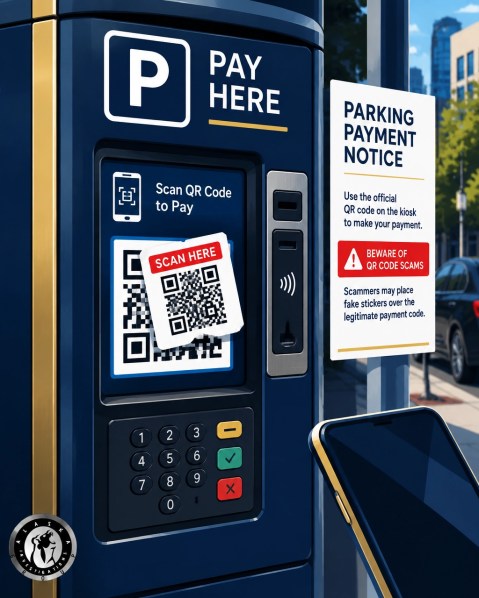
The broader pattern, tracked by researchers as “Operation Road Trap,” involves fake toll, traffic-violation, and parking messages. These messages may include official-looking notices, links, or QR codes and may threaten license suspension or arrest if payment is not made immediately.
The rule is simple: do not treat appearance as verification.
A legitimate government agency does not collect a fine through an unexpected text message or a QR code supplied in that message. A sticker can be placed over a legitimate code. A logo can be copied. A notice can be formatted in minutes.
Alaska has few toll roads, so the fake-toll version has less natural cover here. But the technique transfers directly to an Anchorage parking meter, municipal utility notice, permit or license communication, mailed notice, or QR code posted at a business.
We are not aware of a specific reported Alaska QR-sticker prosecution at the time of writing. The reason to take the technique seriously is that it requires no Alaska-specific setup.
3. Romance Fraud Becomes Investment Fraud
Romance and investment fraud is the largest category here by dollars, and it often begins with no obvious fraud at all.
It begins with a relationship.
“Pig butchering” describes a prolonged process in which a person or team builds trust through friendship or romance, then directs the victim toward a fake investment platform. The victim may see fabricated account balances or apparent profits before being pushed to send more money.
In April 2026, the U.S. Department of Justice announced coordinated international action involving at least 276 arrests and the dismantling of at least nine alleged scam centers used for cryptocurrency investment fraud targeting Americans.
Federal prosecutors charged several defendants in the Southern District of California. The charging documents alleged that individuals working with organizations called Ko Thet Company, Sanduo Group, and Giant Company managed or recruited workers for scam centers. The alleged schemes encouraged victims to borrow from friends and family and take out loans to invest more.
The charges are accusations. The defendants are presumed innocent unless proven guilty.
The FBI reported that Operation Level Up had notified almost 9,000 victims and estimated that it had helped prevent approximately $562 million in losses as of April 2026. The Department of Justice also reported that its Scam Center Strike Force had restrained more than $700 million in cryptocurrency.
The U.S. Department of Justice reported that Daren Li, 42, was sentenced in the Central District of California in February 2026 to 20 years in prison for his role in an international cryptocurrency investment conspiracy run from scam centers in Cambodia. He pleaded guilty in November 2024 to conspiring to launder victim funds. The sentence was imposed in absentia; the DOJ stated he is a fugitive after removing his ankle monitor and absconding in December 2025. Per the DOJ, he admitted that co-conspirators approached victims through unsolicited social media contact, calls, messages, and online dating services, and built trust by establishing professional or romantic relationships before directing them to spoofed investment platforms.
Alaska’s Numbers
The Alaska counterpart is substantial.
According to the FBI’s 2025 Internet Crime Report, as reported by the FBI Anchorage field office and the Anchorage Daily News, Alaskans reported nearly $40 million in losses from cyber-enabled crime in 2025-the highest annual figure recorded for the state.
Approximately 46%, or about $18.6 million, was tied to cryptocurrency. Confidence and romance fraud accounted for $7.1 million in Alaska losses. Alaskans age 60 and older reported $16.2 million in losses, including $4 million from romance scams.
These are reported losses, not a complete measure of every fraud. Many victims never report because of shame, confusion, or fear that others will blame them.
A July 2026 Anchorage Daily News report published a first-person account from a woman who understood that the person she loved was not real and still felt love for him. That is not evidence of gullibility. It demonstrates the mechanism: deliberate trust-building over time.
The person on the other end may not be one person at all. It may be a team following a script.

The Same Pressure, Everywhere
All three categories share the same structure.
First, technology is not the core vulnerability. Contractor fraud predates the internet. The common factor is a motivated decision made under pressure.
Second, manufactured urgency is the delivery system. A roof will fail. A fine must be paid today. An investment window is closing. A loved one needs help immediately.
Third, independent verification defeats the story. Look up the contractor, agency, payment platform, or investment entity through a source you found yourself.
Fourth, distance works both ways. A person accused in one state may be living in another, while a distant authority may decide that recovery is impractical.
Fifth, official appearance means very little. A sticker, notice, logo, license number, or platform can be copied.
Sixth, recovery is not guaranteed. In the Maine contractor matter, a $2.5 million restitution finding became a $350,000 payment plan over 15 years. Prevention is usually more practical than recovery. No one can promise that funds will be returned.
What You Should Do
Keep the response concrete:
- Slow down. Refuse same-day pressure.
- Verify independently. Use an official registry, agency website, or phone number you locate yourself.
- Get written terms. Ask for a written scope of work and do not pay the full amount up front.
- Preserve the record. Photograph notices and stickers. Keep messages, contracts, receipts, correspondence, and original files.
- Report appropriately. Contact the relevant authority, not only your bank or payment provider.
- Stop at cryptocurrency, gift cards, or crypto ATMs. Treat those payment requests as a hard stop.
For additional context on independent verification, see How to Verify a Document Before You Trust It.
Confidential Consultation
If you are dealing with suspected fraud, a vendor that will not account for money, or a documentation question, request a confidential consultation. Consultations are available 24/7 with no obligation for individuals, businesses, insurers, and attorneys.
Call (907) 232-4731 or email mrrems@protonmail.com.
Alaska Investigations Group does not promise recovery or any outcome.
About Alaska Investigations Group
Alaska Investigations Group has more than 10 years of professional investigative experience and serves individuals, attorneys, law firms, businesses, insurers, and government entities.
Licensed Private Investigations Agency in Anchorage, Alaska. License 1126. Serving statewide except Fairbanks.
Investigative work is conducted discreetly, lawfully, and with professionally documented findings suitable for informed decision-making and, when appropriate, professional or legal review.
Frequently Asked Questions
What do contractor scams, QR code scams, and investment scams have in common?
They use manufactured urgency, official-looking information, and a request for money before independent verification. The setting changes, but the pressure pattern is similar.
How do I check whether an Alaska contractor is licensed?
Use Alaska’s Division of Corporations, Business and Professional Licensing contractor resources. Search for the business or individual yourself, confirm active status, and check for the residential endorsement when applicable.
Is a QR code on a parking meter or notice safe to scan?
Not automatically. Inspect the code for signs of an added sticker and use the official app or website instead. Do not rely only on a logo or notice that appears official.
Why do romance and investment scams cost so much more than other fraud?
The relationship develops over time. Once trust is established, the victim may send repeated payments, borrow money, take out loans, or transfer cryptocurrency to a fake platform.
If I have already sent money, what should I do first?
Contact your financial institution immediately. Preserve all records rather than deleting anything, and report the matter to the appropriate authority. Recovery cannot be promised.
General Information Disclaimer
This article is provided for general informational purposes only and is not legal, financial, tax, or law-enforcement advice. References to Alaska statutes, consumer-protection remedies, licensing requirements, reporting agencies, or investigative procedures are general information and may not apply to every circumstance.
Readers should consult their own attorney and contact the appropriate government agency, financial institution, or law-enforcement authority for advice concerning a specific matter. Alaska Investigations Group makes no warranty regarding the accuracy, completeness, applicability, or outcome of any information presented and does not guarantee identification of a responsible person, recovery of property or funds, admissibility of evidence, or any particular result.
Sources
- Bangor Daily News: Maine contractor arrested in Alaska
- Fox 23 Maine: Maine would not pay to extradite contractor arrested in Alaska
- Alaska’s News Source: $64,000 unneeded roof repairs
- Alaska Division of Corporations, Business and Professional Licensing — contractor license search (public registry; search for the agency directly rather than relying on a printed address)
- ABC7 New York: Alleged Manhattan parking QR-code scheme
- Bitdefender: Operation Road Trap
- U.S. Department of Justice: Coordinated scam-center takedown
- FBI Anchorage: Record-breaking cyber-enabled crime losses in Alaska
- Anchorage Daily News: Alaskans lost nearly $40 million to cybercrime
- Anchorage Daily News: Published account of a romance scam
- U.S. Department of Justice: Daren Li sentenced in absentia in $73 million cryptocurrency investment scam


