Alaska Is Not a Safe Haven: How People Who Run From the Lower 48 Are Located

Alaska is remote. It is not invisible.
A person can fly north, travel by ferry, drive the Alaska Highway, work seasonally, use a post office box, move between communities, or limit online activity. Those circumstances can make a location assignment more difficult.
They do not erase every record, relationship, travel pattern, employment connection, or corroborating lead.
That distinction matters when someone has fled to Alaska, when a fugitive is reportedly found in Alaska, or when a family asks, “Can someone hide in Alaska?”
The answer is more precise than a simple yes or no.
Alaska’s geography changes the method. It changes travel planning, records research, interviews, fieldwork, weather considerations, and verification. But distance is not immunity. Alaska is part of the United States, and lawful investigations can cross state lines.
The following ten public examples illustrate that point. They do not establish a universal statistical trend, and Alaska Investigations Group did not participate in any of these matters.
They span more than a decade and ten different origin states, and the locations involved range from Anchorage and Fairbanks to Ketchikan, Juneau, Palmer, Wasilla, Soldotna, and Eagle River.
An arrest, warrant, or extradition proceeding is not a finding of guilt. Readers should review the original reporting for complete context.
Ten Documented Examples
These are drawn from published reporting across more than a decade and ten different origin states. They are presented in roughly chronological order by arrest, and each is attributed to its source.
A note before reading them: an arrest, warrant, or extradition is not a finding of guilt. Several of these matters involve serious allegations, and a few were still pending in court at the time of the reporting. Readers should review the linked reporting for full context, and the details below are limited to what the cited source states about location, arrest, and extradition.
Florida to Eagle River: twenty years on the run
In 2014, the FBI arrested Joseph Keenan May, then 60, at his home in Eagle River. He had been the subject of a federal warrant for unlawful flight to avoid prosecution since 1993, following allegations in Manatee County, Florida. Reporting stated that he had been living under the identity of a stepbrother who died in the 1970s, and that he had lived under other names in Houston in the Mat-Su Valley, in Fairbanks, and in Eagle River. Reporting also noted he had worked at jobs that did not require detailed background checks, and that a Social Security number issue eventually drew federal attention. This is the most instructive example in the list: two decades, multiple Alaska communities, and an assumed identity did not prevent a locate.
Source: Daily Kos community report citing the Bradenton Herald and Anchorage Daily News
Maryland to Juneau: arrested aboard a cruise ship
In 2015, Scott Tomaszewski, 31, was arrested in Juneau while on a cruise with family members, in connection with the deaths of a couple at their Rockville, Maryland home. He waived extradition shortly afterward. The reporting described how a retired police sergeant connected a much older burglary at the same address to the current investigation — an example of an investigative thread that survived nearly two decades and crossed the country.
Source: NBC4 Washington
California to the Sterling Highway: a routine traffic stop
In 2019, troopers stopped a truck for speeding near mile 75.5 of the Sterling Highway. The driver, identified as Robert Wayne Hughes, 47, of Soldotna, came back through a records check as a fugitive from justice out of California on an original charge of vehicle theft. California authorities confirmed the charge and his eligibility for extradition when contacted directly. He was held at Wildwood Pretrial Facility to await transport. The lesson is plain: the locate came from ordinary public activity, not from a search of the wilderness.
Source: Alaska Native News
Texas to Anchorage: held on a manslaughter warrant
Raymundo Miguel Gamboa of Lubbock, Texas was charged with manslaughter in connection with a January 2020 fatal collision. His arrest warrant issued in July 2020. Within about a week, Lubbock police were notified that he was being held in Alaska on that warrant, and he was extradited from Anchorage. Reporting did not describe how the connection was made — a useful reminder that an arrest report often confirms the outcome without disclosing the method.
Source: KFYO Lubbock
Alabama to the Anchorage airport: arrested on arrival
In 2022, James Everett Steen, 34, was met by police when his flight landed in Anchorage, following allegations in Sylacauga, Alabama. Reporting stated that he contested extradition and remained in custody in Alaska for about 60 days before being ordered returned to Alabama, where he was brought back in September of that year. The detail worth noting: the plane landed, and the record preceded him.
Source: CrimeOnline, citing WBRC
Tennessee to a Juneau houseboat: a tip from a prospective employer
In October 2023, Adam James Gabarra, 50, was apprehended by U.S. Marshals after a tip led them to a houseboat in Aurora Harbor in Juneau. The reporting stated he was using his real name and working under the table, and that a person who had interviewed him for a job looked him up and contacted authorities. A U.S. Marshals supervisor quoted in the article noted that people on the run can develop a false sense of safety in Alaska — the thinking being that they have gone far enough.
Source: Juneau Empire
Kansas to Fairbanks: a parking lot standoff
In May 2024, Levi Hart of Montgomery County, Kansas was arrested after a brief standoff in the Bentley Mall parking lot in Fairbanks. He had been wanted on multiple felony drug manufacturing and trafficking charges and for failure to appear. Reporting in Alaska included a statement from a trooper that information about what Hart was likely wearing and driving helped identify an opportunity to locate him, and an explicit statement that Alaska extradites fugitives from justice. Hart was held at Fairbanks Correctional Center awaiting extradition.
Source: KWCH/KTVF
Arkansas to the Mat-Su Valley: a vehicle pursuit
In May 2024, Latrael Hackathron, 37, was arrested in the Matanuska-Susitna Borough after a vehicle pursuit and a foot chase near Colony High School in Palmer. Troopers stated he had an extraditable warrant and that records showed Arkansas burglary, theft, and drug charges. He was remanded to Mat-Su Pretrial, and additional Alaska charges were filed from the pursuit itself.
Source: Alaska's News Source (KTUU)
Tennessee to Ketchikan: months after leaving Nashville
In July 2026, Michael Shane Vaughan, 46, was arrested in Ketchikan. According to the U.S. Marshals Service, he was wanted by the Metropolitan Nashville Police Department on two rape counts and had last been seen in Nashville the previous September. Officials said he had told relatives he would flee to Alaska, where he had ties and had previously lived. He was held at Ketchikan Correctional Center pending extradition. The reporting also stated that it was unclear how authorities learned he was in Ketchikan — another reminder that the public record often shows the result without the method.
Source: Anchorage Daily News
Massachusetts to Anchorage: located at a residence
In August 2026, John R. Monge was arrested at his Anchorage residence after U.S. Marshals located him in connection with charges filed in Massachusetts related to an alleged 2024 incident. He was held pending his return to Massachusetts. Reporting stated that he had allegedly traveled from Anchorage to Massachusetts — the reverse of the usual pattern, and a reminder that movement between Alaska and the Lower 48 goes both directions and creates records either way.
Source: Boston.com
What These Cases Actually Show
These ten public examples support several limited, defensible conclusions:
-
Public and professional coordination can cross state lines.
A matter originating in Kansas, Tennessee, or Massachusetts can involve activity in Fairbanks, Ketchikan, Juneau, or Anchorage. -
Tips and relationships can matter.
A relative, prospective employer, acquaintance, or other contact may provide information that connects a person to a community. -
Using a real name does not make someone invisible.
It may make identity verification more straightforward when other information is independently corroborated. -
Remote geography creates logistics, not immunity.
Travel schedules, ferry routes, aircraft access, seasonal work, and weather can complicate an investigation. They do not automatically eliminate leads. -
Extradition is a legal process.
A private investigator does not arrest a fugitive, issue a warrant, order extradition, or return a person to another state. Those functions belong to authorized governmental agencies and the courts.
These cases should not be used to claim that Alaska is uniquely easy to search or that every person who travels there can be found. They show only that the idea of Alaska as a magic vanishing point is inaccurate.
Fleeing Is Not the Same as Going Missing
A wanted person, a missing adult, and an adult who voluntarily leaves are different categories.
The lawful objective changes depending on the circumstances.
- A person wanted on an active warrant is a law-enforcement matter.
- A missing or endangered person may require an immediate emergency response.
- An adult who voluntarily leaves may have a legal right to privacy and may not want contact.
- A witness, heir, defendant, employee, or debtor may require a locate for a lawful civil or business purpose.
A locate of a willing adult does not automatically mean that a private investigator can disclose the person’s address, force contact, or compel a return.
If someone may be missing, injured, endangered, or lost in remote terrain, contact 911, local law enforcement, or the Alaska State Troopers immediately. Private investigative work cannot replace search-and-rescue operations or official missing-person procedures. For additional emergency context, see “Missing in Alaska: What to Do in the First 48 Hours.”
Why Alaska Changes the Method
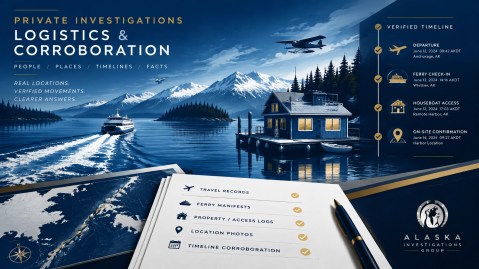
Alaska is not a simple database search.
Depending on the location and circumstances, lawful research may need to account for:
- Small-aircraft and ferry access
- Marine transportation and limited road systems
- Seasonal employment and temporary housing
- P.O. boxes and commercial mail-receiving addresses
- Intermittent connectivity
- Travel between road-connected and remote communities
- Winter daylight and weather conditions
- Local knowledge and community relationships
A person may live in Anchorage, work seasonally near a coastal community, receive mail through a P.O. box, and maintain a vehicle registered elsewhere. Another person may move between temporary jobs or stay with relatives.
Those facts do not create spy-fiction obstacles. They create a logistics problem requiring careful sequencing and corroboration.
What Lawful Locating Involves
A professional locate begins with scope and lawful purpose.
The investigator needs to understand why the person is being sought, what information the client already possesses, and what use will be made of the findings. The assignment must have an identifiable lawful basis.
Depending on the matter, the process may include:
- Public-source and records research
- Identity and name-variation verification
- Review of information lawfully held by the client
- Address, vehicle, employment, or property research where legally available
- Comparison of independent sources
- Interviews conducted without impersonation or pressure
- Field observation only where lawful and appropriate
- Documentation of source dates and limitations
- Separation of confirmed facts, unverified leads, and investigator inferences
A single database hit is not proof. An old address is not necessarily a current location. A social-media post may be misdated, copied, or connected to the wrong person.
Good investigative work asks whether multiple independent facts support the same conclusion.
A private investigator cannot access protected phone, bank, account, or location records without lawful authority. A private investigator does not have law-enforcement access, special government authority, or the ability to bypass privacy protections.
What a Private Investigator Cannot Do
Alaska Investigations Group does not:
- Hack accounts, devices, or databases
- Obtain protected records through deception or pretexting
- Trespass on private property
- Install tracking devices without lawful authority
- Harass, threaten, or pressure a person
- Impersonate law enforcement or another official
- Interfere with an active law-enforcement matter
- Promise that a person will be found or returned
The firm declines assignments without an identified lawful basis.
The objective is not to create drama. It is to clarify what can be verified, document what remains uncertain, and handle sensitive information responsibly.
What You Should Document First
Families, attorneys, insurers, and organizations can make a lawful locate more efficient by organizing the information they already possess.
Document:
- The last-known timeline
- The lawful reason for the locate
- Names, aliases, and addresses already known
- Vehicle and employment information lawfully held
- Known relatives, associates, or professional connections
- The source and date of every lead
- Prior contact attempts
- What has been confirmed
- What remains unverified
Do not confront a person based on an unconfirmed lead. Do not attempt unauthorized tracking. Do not assume that a possible address is proof of a current residence.
A structured record helps distinguish information from assumption.
Alaska Is Remote, Not Invisible
Alaska can be difficult to reach. It can be difficult to search. It can require additional travel planning, local coordination, weather awareness, and careful corroboration.
But Alaska is not a magic-vanishing point.
The documented cases above show that distance changes time, cost, logistics, and method. They do not establish certainty. No legitimate professional should promise that every person can be found, that an address can always be disclosed, or that a person can be forced to return.
Alaska Investigations Group is a Licensed Private Investigations Agency in Anchorage, Alaska. License 1126. Serving statewide except Fairbanks. The firm brings more than 10 years of professional investigative experience to lawful locating, people-locating, research, digital intelligence, and documentation assignments.
Request a Confidential Consultation
If you have a lawful locate or documentation question, request a confidential consultation with Alaska Investigations Group.
There is no obligation. Consultations are available 24/7.
Phone: (907) 232-4731
Email: mrrems@protonmail.com
Not every request can be accepted. Some matters belong with law enforcement, emergency services, or qualified legal counsel.
Frequently Asked Questions
Can someone really hide in Alaska?
A person may reduce their public footprint through remote living, seasonal work, limited connectivity, or use of a mailing address that differs from a residence. However, Alaska is not legally separate from the national records and justice systems. A lawful locate may identify corroborating records, relationships, travel patterns, or other leads, but no professional can promise that every person will be found.
What is the difference between a fugitive and a missing adult?
A fugitive is generally a person sought in connection with an outstanding warrant or legal process. A missing adult may be absent, endangered, or simply out of contact, and the circumstances require evaluation. An adult who voluntarily leaves may have a right to privacy. These situations have different lawful objectives and should not be treated as interchangeable.
Can a private investigator obtain phone or bank records?
Not without lawful authority. Private investigators cannot simply access protected phone, bank, account, or location records. They must comply with applicable privacy and access laws and may rely only on information lawfully available to them.
Does a P.O. box make someone impossible to locate?
No. A P.O. box identifies a mailing arrangement, not necessarily a residence. It may limit one source of information, but other lawful records, relationships, employment connections, vehicle information, or independent leads may still exist. A P.O. box alone neither proves concealment nor establishes a person’s current location.
Can an investigator force an adult to return or disclose their address?
No. A private investigator cannot force an adult to return, compel contact, or automatically disclose a private address. A willing adult may have privacy rights. Warrants, arrests, extradition, custody, and compelled disclosure are matters for authorized agencies, courts, and qualified counsel.
General Information Disclaimer
This article provides general information only. It is not legal advice and does not create an attorney-client relationship. Arrests, warrants, allegations, extradition proceedings, and reported charges are not findings of guilt. Readers should consult the linked original reporting for context.
Investigative methods, record access, surveillance, interviews, privacy, disclosure, and release of findings are subject to applicable federal, state, and local law. Alaska Investigations Group does not have law-enforcement authority, law-enforcement access, or the power to arrest, extradite, compel disclosure, or return any person. No result is guaranteed. Questions involving criminal proceedings, custody, privacy, service of process, emergency response, or extradition should be directed to qualified legal counsel and/or law enforcement.
Sources
- Daily Kos community report citing the Bradenton Herald and Anchorage Daily News — Florida case, 2014
- NBC4 Washington — Maryland case, 2015
- Alaska Native News — California case, 2019
- KFYO Lubbock — Texas case, 2020
- CrimeOnline, citing WBRC — Alabama case, 2022
- Juneau Empire — Tennessee case, 2023
- KWCH/KTVF — Kansas case, 2024
- Alaska's News Source (KTUU) — Arkansas case, 2024
- Anchorage Daily News — Tennessee case, 2026
- Boston.com — Massachusetts case, 2026


